(July 22-23, 2026) LITTLE ROCK — Around 12:30 p.m. on a seemingly ordinary rainy afternoon late last summer, the University of Arkansas, Fayetteville, campus was thrust into chaos. A 911 call reporting an active shooter at Mullins Library prompted a campuswide emergency alert carrying a chilling directive: “Avoid. Deny. Defend.”
Emergency dispatchers and campus phone lines were inundated with nearly 350 calls originating from seven buildings across the sprawling campus. Social media quickly ignited with speculation. Families and friends searched for information. News organizations mobilized.
Within two hours, campus, local, state and federal law enforcement officers had methodically cleared each targeted building. No evidence of a gunman or violence was found, and the campus lockdown was lifted.
No shots were fired.
The incident ultimately coincided with a series of hoax, or “swatting,” calls targeting colleges and universities across the country that same week.
Still, the event left university leaders asking important questions: Did we respond appropriately? Were our internal and external communications effective? What if the threat had been real? How could we improve our preparedness and response?
Those questions, along with a separate threat at another University of Arkansas System institution around the same time, prompted UA System President Jay B. Silveria to make public safety and emergency preparedness a systemwide priority for the state’s largest higher education system, which serves approximately 80,000 students and employs 35,000 faculty and staff.
University of Arkansas at Fort Smith Chancellor Terisa Riley, Ph.D., was appointed to lead a newly formed emergency preparedness committee. Regular meetings followed, and a team of graduate-level researchers from the Clinton School of Public Service was also tasked with studying emergency preparedness across the system and providing recommendations.
This week, those first-year efforts culminated in the UA System’s first-ever Public Safety Conference, hosted by the University of Arkansas for Medical Sciences (UAMS). The two-day event brought together emergency management, law enforcement and public safety leaders from all 22 UA System campuses, divisions and units to share best practices, strengthen partnerships and discuss the future of emergency preparedness.
Building a Culture of Preparedness
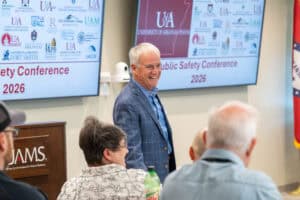
“This event is so important because the two greatest assets we have in our ability to execute our mission as a system are our employees and our students,” Silveria told more than 75 attendees during the conference’s opening session. “We’re tasked not only with educating and training them but also with providing safe spaces in which to operate.
“We collaborate across the UA System on everything from academic programming to vendor contracts to health and benefits,” he continued. “There’s no reason we shouldn’t be collaborating on emergency preparedness, safety planning and response to ensure best practices at our campuses, divisions and units that touch every county of Arkansas.”
Organized by Terry Jones, executive director and chief security officer in the UAMS Department of Public Safety and Operations Support Services, the conference featured more than a dozen speakers representing UA System institutions, the Little Rock Police Department, Arkansas State Police, the Federal Bureau of Investigation, and Arkansas Attorney General Tim Griffin, among others.
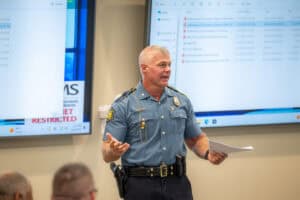
“I can’t express to you how important it is to have a plan during times of chaos,” Arkansas Attorney General Tim Griffin said, reflecting on his military service and training. “Collaboration, communication and training — especially within a broad organization like the UA System — are all essential to generating positive outcomes. I commend you all for coming together for the greater good.”
Sharing Expertise Across the System
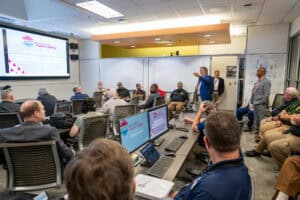
Held July 22–23 at The Orthopaedic & Spine Hospital (TOSH) at UAMS, the conference began with a welcome from UAMS Chancellor Dr. Lowry Barnes, who highlighted the importance of public safety and emergency preparedness at an institution that includes a health sciences campus, a major workforce of more than 12,000 and a fully operational public hospital.
“When it comes to things to be on the lookout for, you name it — we’ve seen it,” Barnes said. “And it never surprises me how often we’re required to prepare for situations we never imagined might occur. We run a highly sophisticated safety operation here at UAMS, and we’re constantly evolving and leveraging technology to provide a safe, welcoming environment for our employees, students and guests.
“I’m pleased you’re all here collaborating,” he added. “The UA System is better off in the long run because of it, and we’d like to do what we can to help and be a part of this team.”
UA System leaders provided updates on a range of topics affecting campus safety and operations. General Counsel David Curran and Associate General Counsel Amber Schubert discussed legal and compliance developments, while Chris Thomason, vice president for strategic and community college partnerships, highlighted examples of collaboration across the system.
“With as much success as we’ve had finding innovative ways to improve academic access and student success, there’s no reason to believe we can’t do the same when it comes to public safety and wellbeing,” Thomason said. “I encourage everyone to think about how the lessons learned on one campus can help another campus operate more efficiently or be better prepared.”
UAFS Chancellor Riley and Chief of Staff Jennifer King provided an update on the systemwide emergency preparedness committee, outlining both accomplishments and ongoing challenges discovered during its first year.
Matt Mills, assistant chief of police at the University of Arkansas, Fayetteville, reviewed lessons learned from last summer’s swatting incident. Eric Wall, chief information security officer for the UA System, discussed cybersecurity threats and strategies for maintaining vigilance, while Alicia Corder, executive director of the UA System Criminal Justice Institute, highlighted law enforcement training opportunities and future educational initiatives.
UAFS Chief of Police Ray Ottman shared insights from tabletop exercises — discussion-based emergency preparedness simulations that allow leaders to evaluate response plans, clarify responsibilities and identify gaps before a real-world incident occurs. Attendees also exchanged ideas for scenarios applicable to their own campuses.
John Kidwell, chief of police at the University of Arkansas at Monticello, and Chris Bentley, assistant chief of police at the University of Central Arkansas, presented on Clery Act reporting requirements, including campus crime statistics, public crime logs and timely safety notifications.
Looking Ahead
Conference attendees also toured the UAMS Emergency Operations Center, a state-of-the-art command and communications facility designed to support emergency monitoring, assessment and response efforts.
Wright Cookus, senior director of emergency management for the UAMS Department of Public Safety, explained that the center operates continuously, with personnel prepared to respond around the clock.
Although the inaugural conference focused primarily on law enforcement and public safety leaders from within the UA System, organizers already envision broader participation in the future.
“The intention initially was to operate within a close-knit group across the UA System to gain a better understanding of what we’re doing, where we can improve and, simply, to get everyone in the same room,” Riley said. “This effort has the potential to become even more expansive and inclusive as a statewide initiative. There’s every reason to share resources and work from a common understanding when it comes to safety and emergency preparedness.”
As the conference concluded, one theme remained clear: collaboration and preparation are essential to protecting the students, employees and communities served by the UA System. The inaugural Public Safety Conference laid the foundation for a more coordinated, proactive approach to emergency preparedness across the state.